Hello,
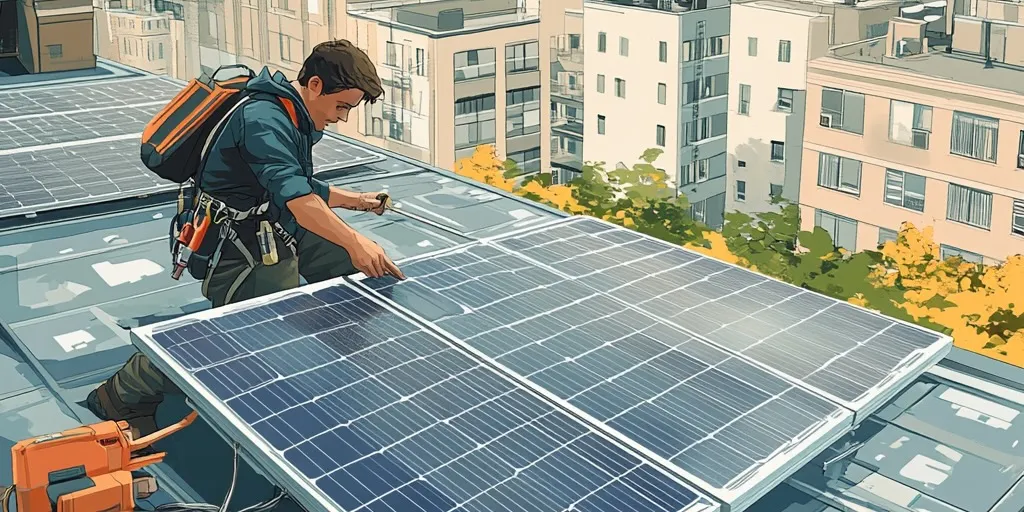
I recently installed solar panels on my flat roof and wanted to share my experience for those considering taking the leap. If you have any tips for optimizing the setup, I’m all ears!
Solar Kit
I purchased the “1520W Plug&Play Solar Kit - 4 Honor 380W Solar Panels + 2 Hoymiles HMS800W 2T Micro-Inverters” from Dealabs: https://www.dealabs.com/bons-plans/kits-solaires-1520w-plugplay-2832592.
Buying a complete kit seemed like a better choice for my first purchase. It provided a single point of contact for any issues (delivery defects, etc.), ensured compatibility between the panels and micro-inverters, and came at an attractive price.
My roof measures 7x4m, allowing space for 8 to 10 panels. Initially, I started with one kit.
Component Choices - Slabs
I wanted a low angle for the installation to remain discreet (or even invisible) from the street. Unfortunately, the parapet is less than 20 cm high on the street side, and with only 4 meters of width, the installation remains somewhat visible regardless of the layout.
The price of pre-made bases was high, and they concentrated weight at a single point. I had doubts about my roof’s capacity, as it wasn’t specifically designed for solar panels (though the beams are closer together than usual, as I had anticipated possibly installing panels one day).
Rails seemed like a solid option, but I didn’t want to drill into the roof to preserve its waterproofing.
I opted for a solution distributing the weight across 4 points using a support system split into four parts with slabs, ensuring recommended weight limits were respected.
For one panel, at least 50-60 kg of ballast is needed. Simple slabs from Leroy Merlin, costing €2.50 each and weighing 13.2 kg, were ideal for this: https://www.leroymerlin.fr/produits/terrasse-jardin/terrasse-et-sol-exterieur/dalle-de-terrasse/dalle-de-terrasse-beton/dalle-beton-spring-au-m2-gris-l-40-x-l-40-cm-x-ep-32-a-35-mm-65965592.html.
I used four slabs per panel for my 4-panel kit, totaling around €41, providing about 53 kg of ballast per panel.
Component Choices - Support
I wanted low-angle supports that could easily attach to the slabs. I chose this model: https://amzn.to/3BFgLMD, costing €57 for two panels or €114 for my kit.
I secured them at the center of each slab.
To avoid damaging the roof, I added thick foam under the supports. I used these rubber mats: https://www.leroymerlin.fr/produits/revetement-sol-et-mur/sous-couche-sol/plaque-de-sol-caoutchouc-sol-anti-vibrations-noma-rub-l-0-6-m-x-l-0-6-m-x-ep-10-66129294.html, cutting them into four pieces to cover about 70% of each slab’s surface.
These mats act as an interface between the slabs and the roof (no direct slab-to-roof or screw-to-roof contact), protecting against wear over time.
Panel Installation
Once the supports and slabs were in place, I installed the panels. I positioned the slabs, then placed the panels in pairs, with the micro-inverter underneath.
The process is simple, but it’s easier with two people—one to hold the panels while the other secures them. It’s also helpful for repositioning the panels if needed. My 4-point system is easier to handle than heavy bases (~60 kg), but it’s best to choose the placement carefully from the start.
Electrical Connection
I chose not to plug the system directly into a socket. Instead, I connected it to my existing electrical panel via an existing 16A circuit breaker. If needed, a circuit breaker costs about €12.
I already had electrical conduit, but you can buy it for around €30, depending on your installation’s distance, to protect the electrical cable on the roof.
Mobile App
I use the S-Miles Home app to monitor energy production in real time. Here’s a preview of the interface:
Total Cost
Kit €570 + €40 slabs + €52 mats + €114 supports = €776.
I already had screws and circuit breakers. The total cost would be around €800 for those starting from scratch.
Installation Optimizations
Two weeks later, I decided to double the installation. I used the same components: kit, slabs, supports, and rubber mats.
I also separated the electrical setup for the annex and the panels. I purchased a waterproof electrical box: https://amzn.to/3NqCYjS (€19), an RCD switch https://amzn.to/401Hzk4 (€47), and a surge protector https://amzn.to/3YldRFx (€70). I also added two 16A circuit breakers.
The surge protector is an extra precaution, and I also grounded the panels using 6mm² wire with these grounding clips: https://amzn.to/4dJbwsu (€22).
Everything is connected to a secondary panel, which then links to the house’s main panel.
Optimization Cost: €147 (excluding wiring).
In summary, this solar panel installation has been a great success, and I’m already seeing the first savings on my energy bill. If you have questions or suggestions for further optimizations, feel free to reach out!